
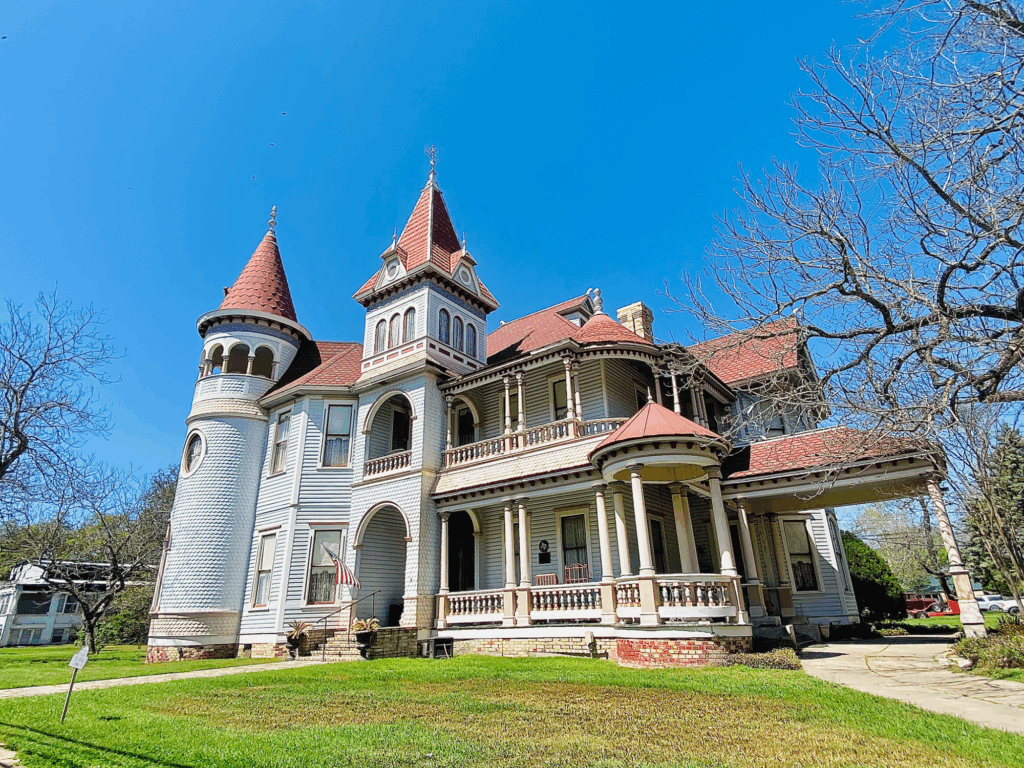
Built in 1895 for cattleman William Buckner “W. B.” Houston, this exuberant Queen Anne residence reflects the wealth and social standing generated by late nineteenth century ranching in Gonzales County. Houston was born May 6, 1852, in DeWitt County to James Andrew Dunn Houston and Julia A. Harris Houston. By his late teens he was driving cattle and, over the next decades, amassed more than 6,000 acres in the county. Contemporary newspaper notes from March 17, 1884 capture the scale of the Houston cattle trade, reporting that “J. D. Houston and others are shipping 10,000 head of cattle to Wichita Falls,” and that “J. D. and W. B. Houston will have 3,000 to 4,000 head of two year olds on the trail in two weeks.”
Houston married Ada B. Lewis on January 30, 1884; their daughter Ada Lewis Houston was born before Ada’s death on January 5, 1889. On December 7, 1892, he married Sue Lewis Jones. Family histories and local tour materials consistently note that Sue, trained in art in Europe, painted murals for the new house. The murals were created on canvas in the attic and then installed on the dining room walls and parlor ceiling, where they remain a defining interior feature.
The property stands at 621 East St. George Street and is listed on the National Register of Historic Places as the Houston, William Buckner and Sue, House (listed July 23, 2003, NRHP reference 03000769). Photography and house-list entries identify it as a three story, towered Queen Anne landmark in the local historic streetscape.
House history and owners
Houston continued ranching and town interests until his death from a stroke on December 22, 1916. Sue Lewis Jones Houston survived him by decades and remained associated with the residence and its celebrated interiors. Both are buried in the local Masonic Cemetery.
Architecture and interiors
The house exhibits hallmark Queen Anne features: asymmetrical massing, corner and front facing towers, an expansive wraparound porch, and rich millwork. Inside are original parquet floors, intricately carved longleaf pine trim, embossed metal ceilings, multiple fireplaces with distinctive mantels, and an impressive staircase rising from a formal foyer. The parlor entrance is framed by tall interior pillars, and pocket doors structure public rooms for entertaining. The conservatory opens off the formal dining room through glass pocket doors. Period sources and tours repeatedly highlight the hand painted murals by Sue Houston as a unique artistic element within Gonzales domestic architecture.