
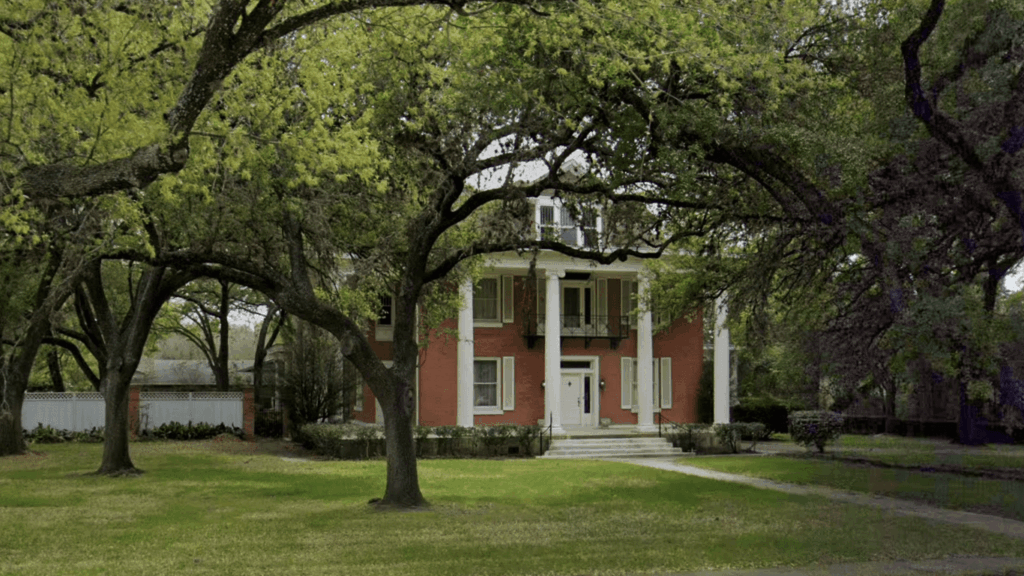
Completed in 1913 for Osborne Bragg Robertson and Susan (Miller) Robertson, this Greek Revival residence embodies the financial and industrial rise of a prominent merchant-banker who later served in the Texas Legislature. Robertson was born November 23, 1861, in Mississippi, moved to Waelder at fourteen, and studied at Scherrer’s Art and Business College in Galveston. He married Susan Miller on March 30, 1887, partnered with her father in mercantile trade, then opened a drug store before shifting decisively into land, banking, brickmaking, lumber, and farming. He was an early stockholder in the Farmers State Bank of Waelder and a key stockholder in Gonzales State Bank & Trust. In 1914 he took control of the Sunset Brick & Tile Company on the Guadalupe, later known as the Gonzales Brick Company. During the banking crises of the early 1930s, Robertson and partners used personal funds to stabilize local banking operations. He died January 12, 1941, and is buried in the Masonic Cemetery.
House history. Deed and booklet references note that Representative O. B. Robertson acquired the St. Louis Street property on July 10, 1913, and completed the dwelling soon after. Heritage photo files for the O. B. Robertson House confirm the location and lot information, anchoring the property on a principal residential avenue established in the late nineteenth and early twentieth centuries.
Architecture and features. The house is a monumental, three-story, pressed-brick mansion set on terraced grounds with a perimeter wall and wrought-iron gates. A broad walk leads to marble steps and a piazza finished in terrazzo. Primary elevations are organized by a colonnade of massive cypress columns, often described as eight in number, framing a symmetrical façade and deep porch. Interiors retain a grand reception hall with mahogany paneling and ceiling beams, oak floors bordered in walnut, birch, and maple, an oversized Rookwood-tiled fireplace, and formal rooms for entertaining, including a long parlor opening to a conservatory, a library, music room, butler’s pantry, dining room, and kitchen. A dramatic stair rises to a bowed landing backed by stained-glass windows, then divides into twin flights to the bedrooms above. Below is a full basement historically finished for service spaces and storage, with a fire-rated vault. Period accounts also note an early central vacuum system. Some traditions hold that the brick was sourced by exchanging production with D’Hanis Brick and Tile to distinguish the house from downtown buildings that used Gonzales-made brick.