
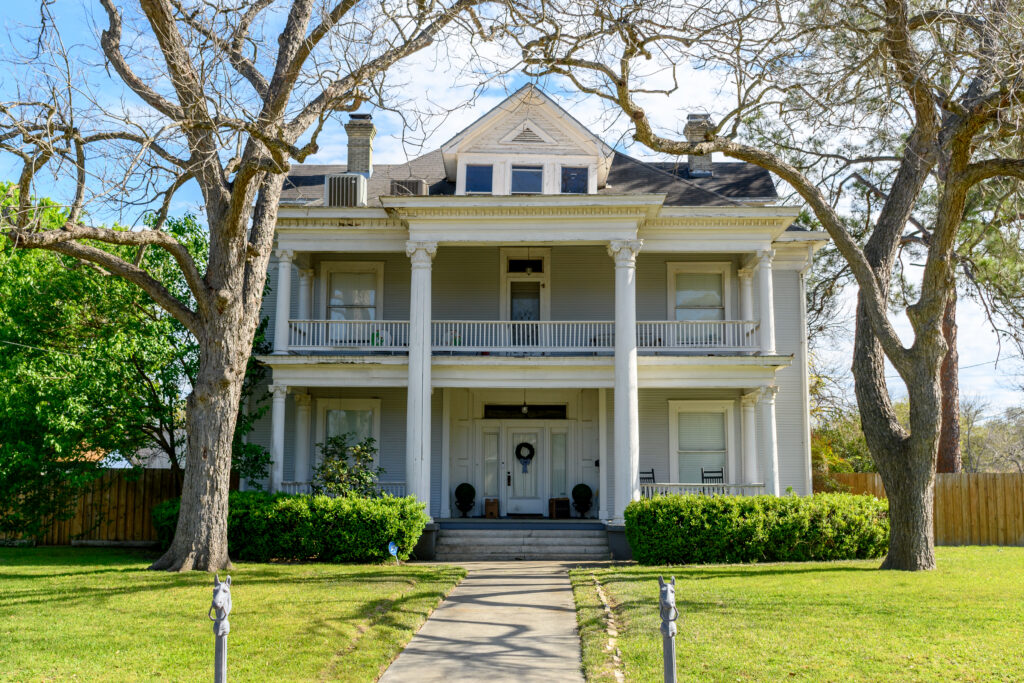
Built in 1885 for physician John Curtis Jones, M.D. and Mary Kennon (Crisp) Jones, this Italianate, L-shaped residence is closely associated with Jones’s medical career and post-war practice in Gonzales. Biographical records confirm Jones’s European medical training (Dublin, London, Paris), his Confederate service with Hood’s Texas Brigade, and his later return to settle and practice locally.
People and context.
Dr. John Curtis Jones (b. 1837, Lawrence County, Alabama) studied medicine in Texas and completed advanced work at the Rotunda Hospital (Dublin) with additional study in London and Paris before returning to Texas in 1861. Attached to Hood’s Texas Brigade, Jones served as surgeon and attended Gen. John Bell Hood after the general’s wounding at Chickamauga; after the war he made Gonzales his home and practice. Local tradition credits Jones with introducing the first hypodermic needle in town in 1865. He married Mary Kennon Crisp on May 23, 1867.
House history
The dwelling was completed in 1885 and is repeatedly described as an Italianate house planned for maximum cross-ventilation, with a characteristic L-shaped footprint and single-room-deep wings. A later iron fence, brick walk, and carriage house augmented the site. Period notes describe a rainwater system that routed water from cedar gutters through charcoal to a cistern. The property appears in a Texas Historical Commission 1975 field photograph labeled “Dr. John C. Jones House” with the original town-lot reference (Block 8, Lot 6).
Architecture and materials
Exterior fabric includes cypress siding; interiors are documented as using seven different woods (floors, wainscoting, trim), notably Gonzales walnut for the grand curved staircase. A pine arch separates the entry hall and parlor, the latter paneled in curly pine. Original descriptions mention a north wing and cupola (both later removed). The house was wired for electricity in the 1890s and is locally cited as the first residence in town with electricity and running water.