
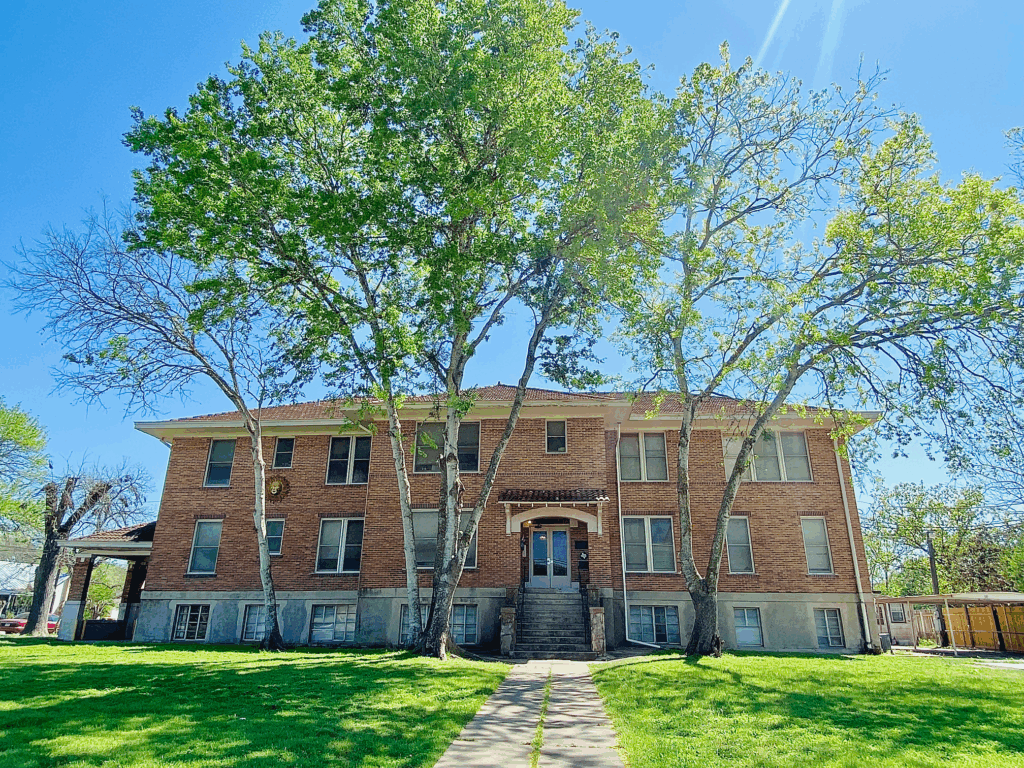
A native of Gonzales County, Dr. George Holmes opened his practice in town in 1915, first setting up above Fitzgerald Drug Store on October 28. On March 25, 1920, he announced a modern hospital for the county seat. Plans called for a two-story brick facility with twenty rooms and a full basement, and Holmes pursued postgraduate training at Johns Hopkins and the Mayo Clinic to bring current methods home. Built by contractor Fred Meisenhelder and completed in 1921, the hospital met needs previously served by smaller private facilities such as the Guadalupe Sanitarium run by Drs. J. A. Manness and G. Schulz. Coming out of World War I and the Spanish Flu, the building symbolized local investment in science-based care and civic progress.
Inside, patient rooms lined broad corridors for light and cross-ventilation, surgery and delivery rooms occupied the brightest exposures, and the basement housed services such as laundry, storage, and mechanicals. Waiting rooms and business offices faced the entry, and finishes favored smooth, sanitary surfaces that could withstand daily cleaning.
Adaptive reuse. In 1983 the former hospital was rehabilitated as The Guadalupe Apartments, an adaptive reuse that created nine residential units while retaining the exterior brick envelope and the building’s civic presence on the street. The conversion extended the lifecycle of a landmark medical facility and kept the structure in daily use.
Designation: Local historic interest as Gonzales’s first fully equipped, purpose-built hospital, later adapted as The Guadalupe Apartments.
Period of significance: 1915–1921 for practice, planning, and construction of the hospital, and 1983 for the adaptive reuse to apartments with continuing residential use thereafter.
Notable owners/associations: Dr. George Holmes; Drs. J. A. Manness and G. Schulz of the earlier Guadalupe Sanitarium; contractor Fred Meisenhelder.
Architecture: Two-story brick clinical block with twenty rooms and a full basement; symmetrical street elevations, ward plan aligned to light and airflow, durable interior finishes suited to early twentieth-century hospital standards; 1983 conversion to nine apartments that preserved the primary exterior fabric and adapted interiors for residential life.