
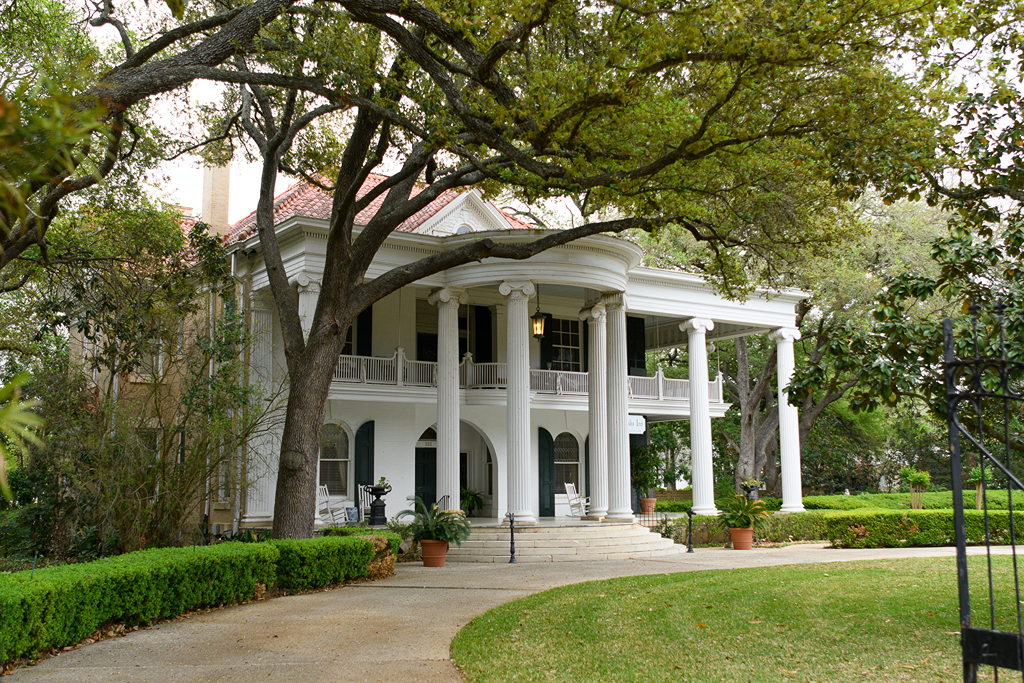
Commissioned by banker Coke Emory “C. E.” Dilworth and Leonora (Lenora) Kokernot Dilworth, this monumental Greek Revival residence was designed by noted Texas architect J. Riely Gordon and completed in 1911–1912. Contemporary Texas sources agree on the architect and the 1911–1912 completion window. Today the house operates publicly as Belle Oaks Inn.
C. E. Dilworth (b. May 13, 1874; d. 1950) was a son of banker George Norwood Dilworth, for whom the railroad town of Dilworth, Texas was named when the SA&AP spur opened in 1889. C. E. married Leonora Kokernot on March 25, 1896, uniting two influential local families in banking and ranching.
House history.
The couple hired J. Riely Gordon about 1908, with construction finishing 1911–1912. Midcentury, the property was used as housing for doctors and nurses serving the nearby Warm Springs Rehabilitation Hospital at Ottine, an institution founded in 1937 and expanded in the 1940s during the polio era. In 1961 a member of the Boothe family acquired the house. A comprehensive restoration and adaptive reuse around 2000–2002 reopened the residence to the public as Belle Oaks Inn.
Architecture and site.
Two story mansion of tan pressed brick with a red tile roof, attributed to Gordon. The front entry is a round portico with fluted Ionic columns that match the column order along a full length L shaped porch, with a second story balcony above. First floor windows are arched with arched shutters. Interiors include marble inlaid terrazzo and parquet floors. Historic grounds featured a carriage house, terrace, and a pond with a carved Italian stone fountain. The classical vocabulary and scale have been compared in Texas literature to plantation era Greek Revival houses between New Orleans and Baton Rouge.
Related Dilworth properties and context.
The family’s commercial footprint included a downtown Dilworth Bank building, documented in regional archives and later reused commercially. The patriarch G. N. Dilworth is also memorialized in the community name Dilworth, Texas, created when the SA&AP ran its spur line through the county in 1889.
Designation: Local historic interest for an architect designed Greek Revival residence by J. Riely Gordon, later adapted as staff housing and now a restored inn and event venue.
Period of significance: 1908–1912 for design and construction; important secondary periods in the 1950s for medical staff apartments associated with Warm Springs, and c. 2000–2002 for restoration and public reopening as Belle Oaks Inn.
Notable owners and associations: C. E. Dilworth and Leonora Kokernot Dilworth (original owners); Warm Springs Rehabilitation Hospital at Ottine (midcentury use); Boothe family stewardship from 1961; current operation as Belle Oaks Inn.
Architecture (concise): Two story Greek Revival by J. Riely Gordon with a full length L shaped porch and second story balcony, round Ionic portico, arched first floor windows with arched shutters, pressed brick walls, red tile roof, and interiors of parquet and marble inlaid terrazzo.