
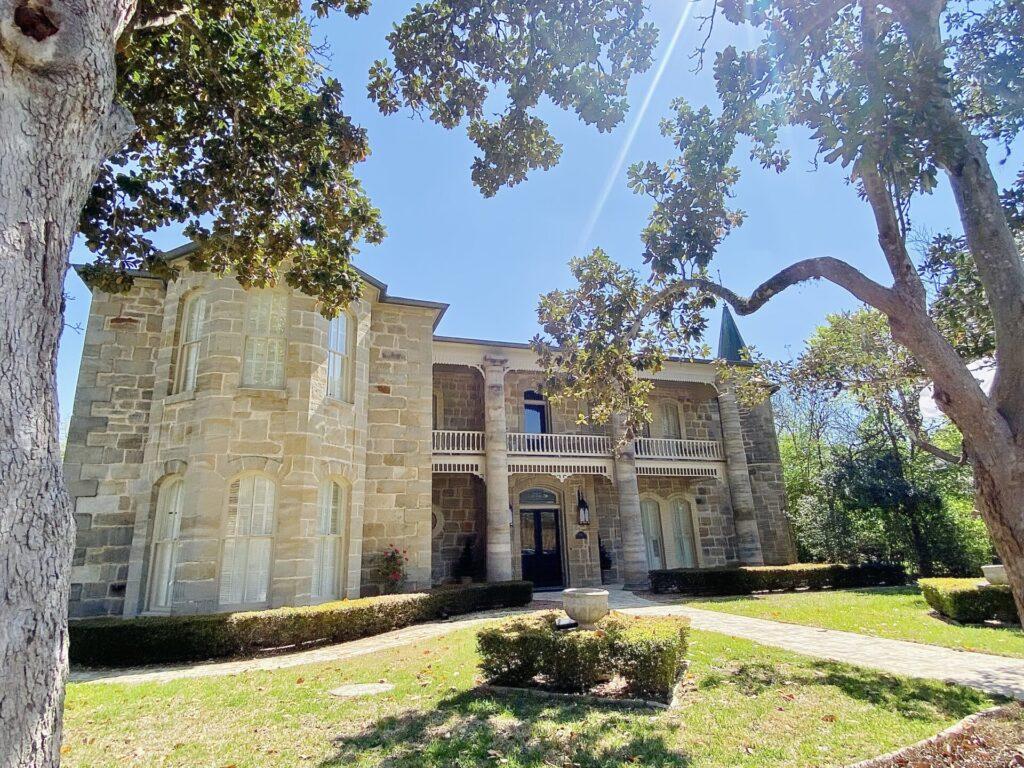
Chartered in 1852 and opened for classes in 1853, Gonzales College quickly rose to statewide prominence. It is credited as the first college in Texas to award diplomas and four-year degrees to women. The original two-story stone classroom block went up in 1851 under builder John Mooney. Community teams hauled stone from Peach Creek by ox cart. The footprint measured about 60 by 34 feet with two full stories that read as a sober, classical temple front supported by a giant-order of Doric columns. Early leadership set a high standard. President John Freeman Hillyer shaped a broad curriculum in rhetoric, moral philosophy, mathematics, natural philosophy, Latin, music, and fine needlework. Trustee board president Thomas J. Pilgrim anchored governance and fundraising and placed the institution in statewide education circles. Enrollment began with about fifty students.
From the beginning, the college treated women’s advanced study as a civic investment. By 1857 the faculty conferred Bachelor of Arts degrees upon female students. Graduates often taught in academies and private schools and took part in study circles, church groups, and aid societies that extended learning into community life. A second building opened in 1855 for men’s courses. War altered the campus. The men’s building was dismantled for nearby defenses at Fort Waul, and the college continued as a coeducational program in the surviving block.
In 1891, alumnus and attorney W. M. Atkinson purchased the decommissioned academic building and converted it to a residence with care. He reused stone from his family’s country house and added an east wing with stone from the Maurin Quarry on Peach Creek. The exterior kept its temple-front severity and public dignity while the interior shifted toward domestic privacy. Large classrooms became chambers, closets, and halls. Eight fireplaces gained mantels made of Gonzales walnut. Floors of tongue-and-groove pine received an oak overlay. An iron fence formalized the grounds. A cupola with a spiral stair introduced a vertical accent and lookout, and it was removed later. The result preserved the scholarly character of the shell while creating a comfortable home.