
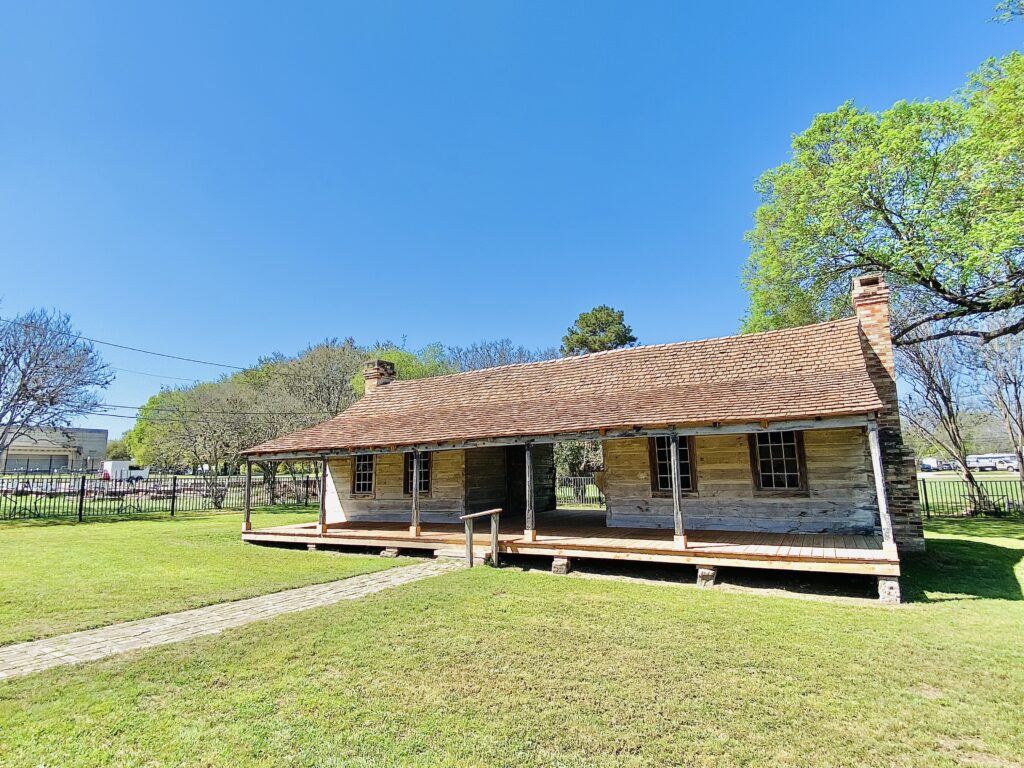
The Eggleston House is an original mid-19th-century dogtrot log dwelling interpreted today as a free, walk-up, self-guided museum. A porch speaker provides a concise audio history while visitors view two illuminated rooms furnished in period style. This arrangement—and the site’s ongoing care—reflect a community effort to preserve one of Gonzales’s most tangible links to early Anglo-American settlement. It is widely regarded as the oldest standing structure in Gonzales.
Origins and family story.
Horace Eggleston (b. 1800, East Bloomfield, New York) arrived in Texas before the Revolution and married Sarah Ann Ponton on May 3, 1835. Sarah’s family had come to Texas by 1829 and endured frontier violence, including the 1834 killing of her father. Horace is associated with the Texas Revolution era; their first child, Amanda, was born near the San Jacinto battleground in May 1836. The family later had four more children, and Sarah’s mother, Isabella Moreland Ponton, is also associated with the household in later years.
Construction and frontier function
After Gonzales was burned during the Runaway Scrape of 1836, the Egglestons rebuilt a permanent home in the 1840s using locally available timber cut from river-bottom hardwoods. Friends, enslaved laborers, and builder Jesse K. Davis are credited in local/family records with raising the house. Its plan is the classic “dog-run” or “dogtrot”: two single rooms divided by an open, breezy passage that served as the home’s sole exterior access, a defensive choice that concentrated entries into a monitored space. Whipsawing squared the logs; half-dovetail notching locked corners tight; moss and clay chinking sealed gaps; and paired exterior end-wall chimneys reflect Anglo-American building traditions brought into Texas. Flooring and trim were also whip-sawn when milled lumber was scarce.
Commerce, education, and civic life
Eggleston resumed mercantile activity after the Revolution and became a local civic leader. He served on the inaugural board of trustees for Gonzales College in the 1850s and appears in period rosters of community officers. These roles place the household within Gonzales’s antebellum economic and educational growth. Horace died in 1855; Sarah later remarried (B. F. Minter) and died in 1880.
Relocation and restoration
In 1954 the structure was carefully moved and re-erected. Because of age and weight, the cabin was disassembled log-by-log; each timber was numbered, and deteriorated pieces were replaced in kind with new logs hewn from nearby sources before reassembly in reverse order. This mid-century preservation effort—typical of the era’s methods—stabilized the house for interpretation. Local stewards, including the Gonzales County Historical Commission and the Gonzales Chapter of the Daughters of the Republic of Texas (DRT), have remained closely involved in public programming and marker stewardship.
Interpretation today
The house functions as an outdoor-access museum: visitors activate an audio box on the porch to hear site history while peering into two furnished rooms that illustrate sleeping, cooking, and daily work patterns of the 1840s–1850s. Longstanding local interpretation highlights the defensive logic of the dogtrot (doors opening only to the central passage), the role of dogs as sentries and work animals, and the ways households adapted construction to climate and material scarcity.


HISTORICAL MARKER TEXT INSCRIPTION
The Eggleston House was one of the first houses built in Gonzales after the Run-Away Scrape and burning of the town in 1836. Horace Eggleston built this house in 1848 and it was one of the first permanent type in Gonzales. The house was erected on Lots No. 1 to 6 Block 15 of the Inner Town of Gonzales which was 600 feet east of the Guadalupe River and on St. Michael Street. Walnut and oak trees were cut from the banks of the Guadalupe River. From the logs with the use of whipsaws and broadaxes, the timbers were cut to build the house. The whipsaw side of the timber was faced to the outside and the broadaxe side to the inside. The thickness of the timbers furnished protection against the Indians and wild animals. Spaces were left between the timbers from which to fire their weapons. The house was built as it is seen today, with two rooms separated by an open space, which was called a dog-run. Each room was provided a fire place. One room was used for cooking and the serving of food. The other room was used for sleeping quarters. When the family had overnight visitors, which was often, one room would be used for men and the other for women. Dogs were a necessity for protection and hunting, and the dogs slept in the dog-run. In 1954, the house was given to the City of Gonzales by Mr. and Mrs. E. E. Smith, Jr. The city council employed Mr. Fred B. Miesenhelder to move the house to city property. Due to the weight and condition of the house, it was necessary to disassemble all the timbers. Each timber was given a number as it was taken down and then reassembled in reverse order. Those parts which had deteriorated were replaced by new logs cut from the banks of the Guadalupe River.