
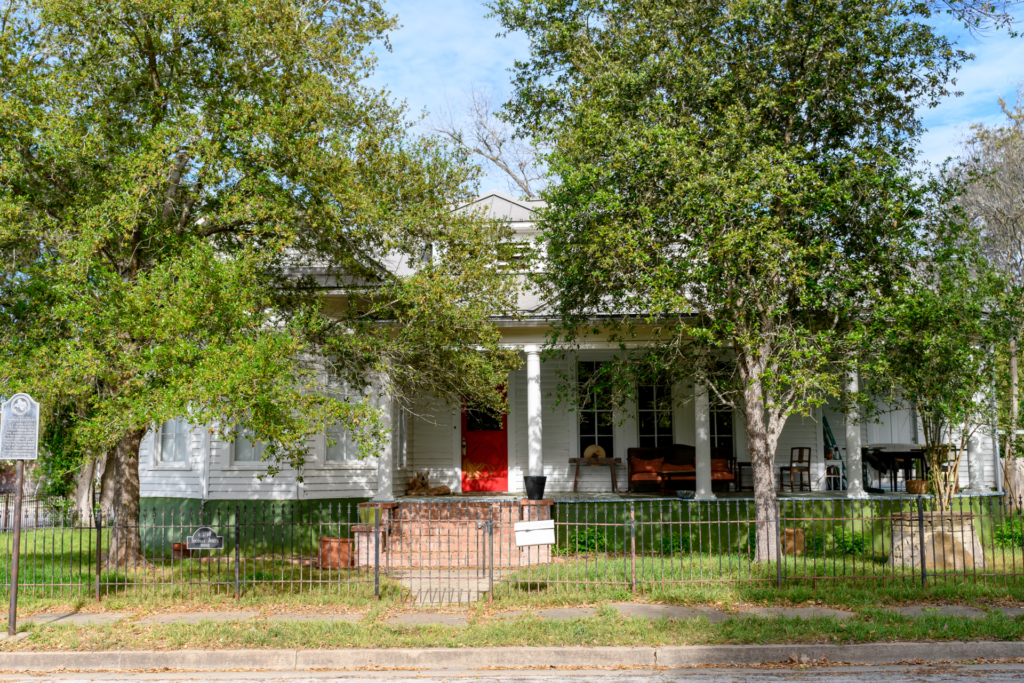
Built in 1893 by merchant Solomon Joseph, this residence stands on ground first settled by Susanna Wilkerson Dickinson and Almaron Dickinson in the early 1830s. The brick cistern in the front yard survives from the Dickinson homestead. It withstood the burning of Gonzales during the Runaway Scrape in 1836 and is the oldest visible land improvement on this tour. The site links a late nineteenth century home to one of the most important family stories of the Texas Revolution.
The Dickinson family and the Texas Revolution
Almaron Dickinson was born about 1800 in Pennsylvania. He married Susanna Wilkerson on May 24, 1829, in Hardeman County, Tennessee. They joined Green DeWitt’s colony by 1831. Almaron purchased a league of land and four lots in Gonzales. He operated a hat factory with George Kimbell, later a fellow Alamo defender. Their daughter Angelina was born in 1834.
Almaron belonged to the Old Gonzales Eighteen, the citizens who refused to surrender the community cannon in October 1835. That confrontation sparked the Battle of Gonzales and is remembered as the start of the Texas Revolution. He served as a lieutenant of artillery during the Siege of Bexar in December 1835 and as an artillery captain during the Siege of the Alamo. At dawn on March 6, 1836, as Mexican forces breached the mission, Almaron told Susanna that all was lost and urged her to save herself and their child. He died in the battle. Susanna and Angelina survived.
Runaway Scrape and return
After the fall of the Alamo, Santa Anna sent Susanna to carry a note to General Sam Houston. She reached Houston in Gonzales about March 12, 1836, and then fled east with thousands of settlers during the Runaway Scrape. Families abandoned homes, livestock, and belongings and endured sickness, storms, and rough travel while seeking safety. Following the Texian victory at San Jacinto, survivors returned to rebuild. The surviving Dickinson cistern at this homesite is a rare material witness to that upheaval and return.
Later life and remembrance
Susanna remarried several times and in 1857 wed Joseph William Hannig, a German immigrant who became a prosperous furniture and cabinet maker in Austin. Their Austin house, built in 1869, now operates as a museum that interprets Susanna’s life. Throughout her later years she gave testimony to help widows and heirs of Alamo defenders secure land grants authorized by the Republic of Texas. Her final known account of the battle dates to the year of her death in 1883, shortly before the Alamo Church transferred to State ownership. A mural on the Josephine Peck building honoring a woman with a child recognizes Susanna and Angelina Elizabeth, and their role in the Gonzales story.