
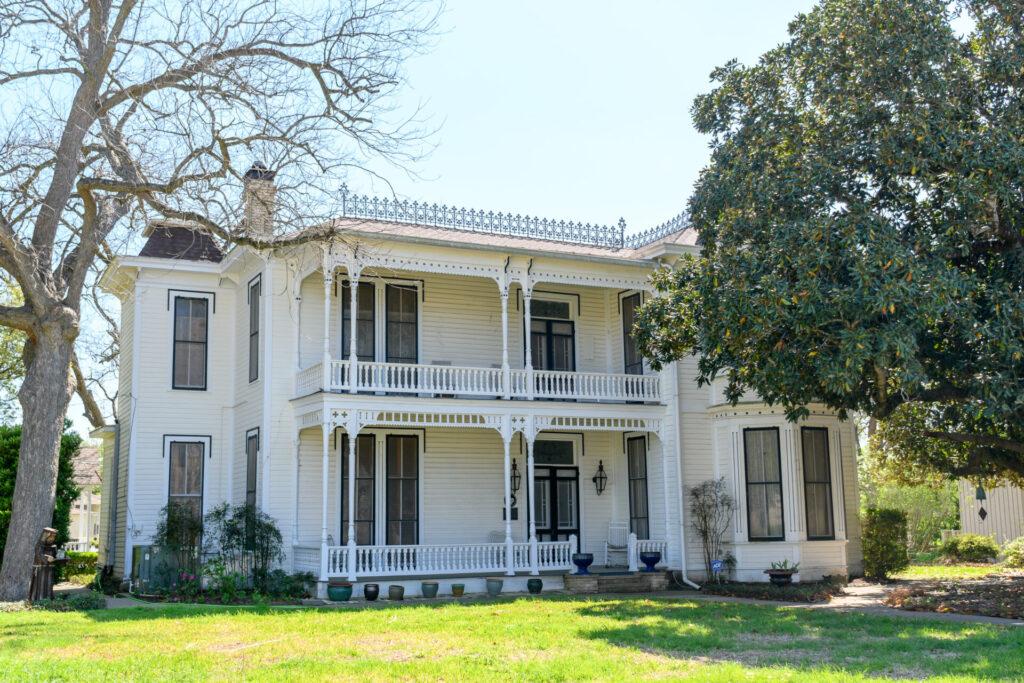
Built in 1892 for merchant–banker Charles Taylor Rather and Ella Gertrude (Grubbs) Rather, this residence is a Victorian interpretation of the early Texas dog-trot plan. Contemporary local accounts note that Rather imported Louisiana cypress and Bastrop white pine for the build and engaged William H. Kishbaugh—listed in the 1896–97 Texas business directory as a Gonzales based carpenter/contractor—to execute the work. The parcel occupies part of the former Gonzales College grounds, tying the house to the community’s nineteenth century educational landscape.
People and context
Charles Taylor “C. T.” Rather (b. June 20, 1855, Huntsville) arrived in the county as a teenager, clerked in Leesville and Belmont, then opened his own store and expanded into land and banking. He served as chairman of the board of the Farmers’ National Bank and helped organize two cornerstone industries at the turn of the century: the Gonzales Cotton Oil and Manufacturing Company (chartered and under construction in 1899) and the Gonzales Cotton Mill (1900). Period press and later scholarship document the cotton oil company’s 1899 contract letting and the town’s rapid cotton industrialization (gins, oil mill, and, by 1901, a textile mill). C. T. also co owned the landmark Randle-Rather Building on the courthouse square, a major commercial block profiled in architectural histories.
House history
Rather built in 1892, sold the property in 1910, and moved to Austin. The house passed through multiple owners during the twentieth century. In 1986 it was purchased by Mary Rather, a great-niece of the original owner; her career included service in Washington as a personal/administrative secretary in the Johnson circle (there is a White House staff reference to Mary Alice Rather in contemporaneous records).
Later life of the owners.
Ella died December 23, 1919; C. T. Rather died October 10, 1931, shortly after returning from the family’s summer stay in Maine. Both are buried in Austin. (Dates per locally compiled family histories; bank/industrial roles corroborated by period press and statewide histories of the cotton-oil and textile sectors.)