
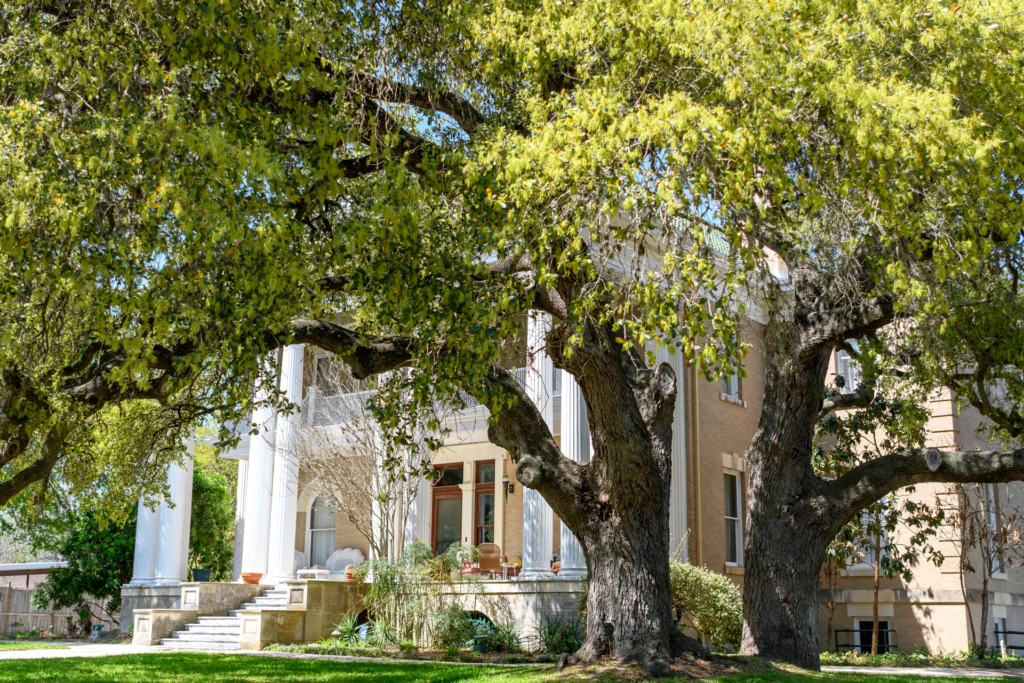
Commissioned by banker Robert Scott “Scott” Dilworth and his wife Susan Martha (Jones) Dilworth, this residence is among the most ambitious early twentieth-century homes in the region and a key domestic work by architect J. Riely Gordon. Scott Dilworth was born September 24, 1868, the son of prominent banker George Norwood Dilworth and Martha Ellen (Huff) Dilworth. Educated at the University of Virginia, he returned home to banking and, in 1900, joined C. T. Rather, Madden Fly, and T. F. Harwood to organize the Gonzales Cotton Mill, a major local employer through the mid-twentieth century. He and his brother Coke E. Dilworth later operated the Dilworth Bank after their father’s death in 1911. Scott married Susan Martha Jones on March 14, 1893; their first home, a Victorian mansion, was completed that year.
House history
In 1906 the Dilworths sold their earlier house and retained J. Riely Gordon to design a new residence. Construction began about 1908 and concluded in 1911, a timeline echoed by multiple independent references and contemporary coverage noting more than three years from planning to completion.
Architecture and site
Gordon’s design presents a monumental classical composition that local and statewide sources identify as Greek Revival in character. The project employs pressed brick from St. Louis and, as period accounts emphasize, was built “without a foot of pine lumber.” The house rises three full stories over a full basement and sits on terraced grounds enclosed by a brick wall and wrought-iron gates. A wide terrazzo walk leads to marble steps and a terrazzo-floored piazza. The front is organized by tall white Corinthian columns that visually extend to the second level, expressing the era’s shift toward formal, monumental classicism in high-status residences.
Interior finishes
The entrance opens to a spacious reception hall with mahogany paneling and tapestry wall surfaces. Massive mahogany ceiling beams structure the space, while the hardwood floor is oak bordered in walnut, birch, and maple. An immense hall fireplace is finished in Rookwood tile in muted olive and blue. To the right, double doors lead to a parlor running the length of the house and into a conservatory; the parlor walls are paneled in quartersawn old English oak. At the far end of the hall, a graceful stair in mahogany with oak treads rises to a landing that bows beneath stained-glass windows admitting northern light, then divides into two flights to the family rooms above. French plate-glass mirrored doors anchor the rear of the hall, which is lit by colonial-pattern chandeliers. A library, music room, butler’s pantry, dining room, and kitchen complete the principal floor. Below, the basement, ventilated and finished in antique oak, historically contained a kitchen, bedroom, and a fire-proof vault for valuables.
Authorship and documentation
State and scholarly references identify the house as a J. Riely Gordon work, highlight the paired giant-order column motif, and note its role in a sibling set of landmark Dilworth houses that illustrate the period’s pivot from Queen Anne forms to classical grandeur. A widely circulated image record fixes the name, architect, style, and 1911 date.
Later Life
Scott Dilworth died of a heart attack on March 28, 1948; Susan died July 4, 1957. Both are interred in the I.O.O.F. Cemetery. Their residence endures as a touchstone for the town’s banking, industrial, and architectural rise in the early 1900s.