
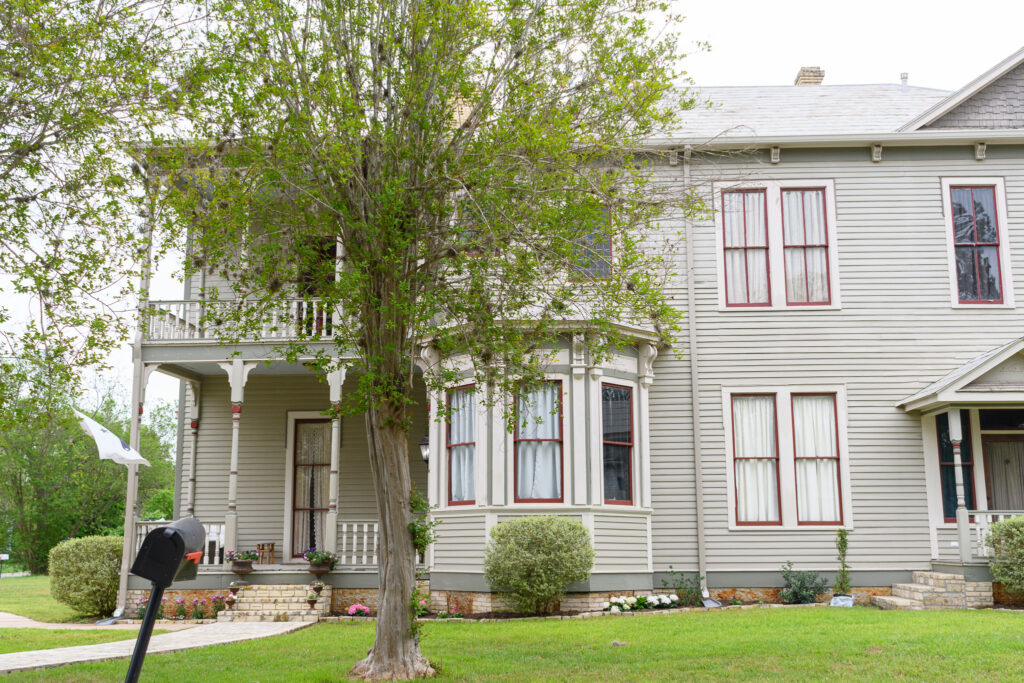
Built in 1898 for William Henry Boothe and Annie Robert (Ragsdale) Boothe, this late-Victorian residence reflects the aspirations of a second-generation merchant family and the singular personality of its well-known mistress of the house.
Owner history
William H. Boothe (born July 2, 1866) was the son of George Jefferson and Mary Ann Jones Boothe. In the 1890s he worked with his father in W. H. Boothe & Company, a general store located just off the square. After the store was sold, William earned his living as a cotton and pecan buyer, a common move for merchants in the river counties at the turn of the century. He married Annie R. Ragsdale on April 29, 1896. Annie, born September 12, 1874, in Lavaca County, was the daughter of William Robert Ragsdale and Susan Prentiss Robinson Ragsdale. Family accounts remember Annie as a Boston Conservatory-trained pianist who later became a sought-after physical therapist, mixing a signature liniment of white gasoline and gum camphor and treating a clientele that reportedly included University of Texas football players. Annie’s reputation as a healer and eccentric is part of local oral history. Family stories recount a pet alligator kept in a small pond that once escaped and was later found near the old cotton mill. While colorful, these details come from family and neighbor recollections rather than formal archival records. William died December 18, 1940; Annie died November 27, 1958. Both are buried in the Odd Fellows (I.O.O.F.) Cemetery at Gonzales.
Construction and site
The couple purchased their lots in 1897 from William’s parents and completed the house the next year. Published house lists and real estate surveys consistently place the W. H. Boothe House at 722 Saint Francis Street, describing it as a prominent corner-lot Victorian with broad porches and a grand stair hall.
Architecture and interiors
The house is a Queen Anne-period composition with asymmetrical massing and a wraparound porch suited to social calling and music lessons. Surviving descriptions note longleaf pine millwork, hardwood floors, tall pocket doors, a grand staircase with a wide landing, multiple parlors, and decorative ceilings. The plan favors a formal front suite for receiving pupils and guests with family rooms opening toward the rear. Later hospitality and sales listings confirm the Victorian finishes and overall arrangement.