
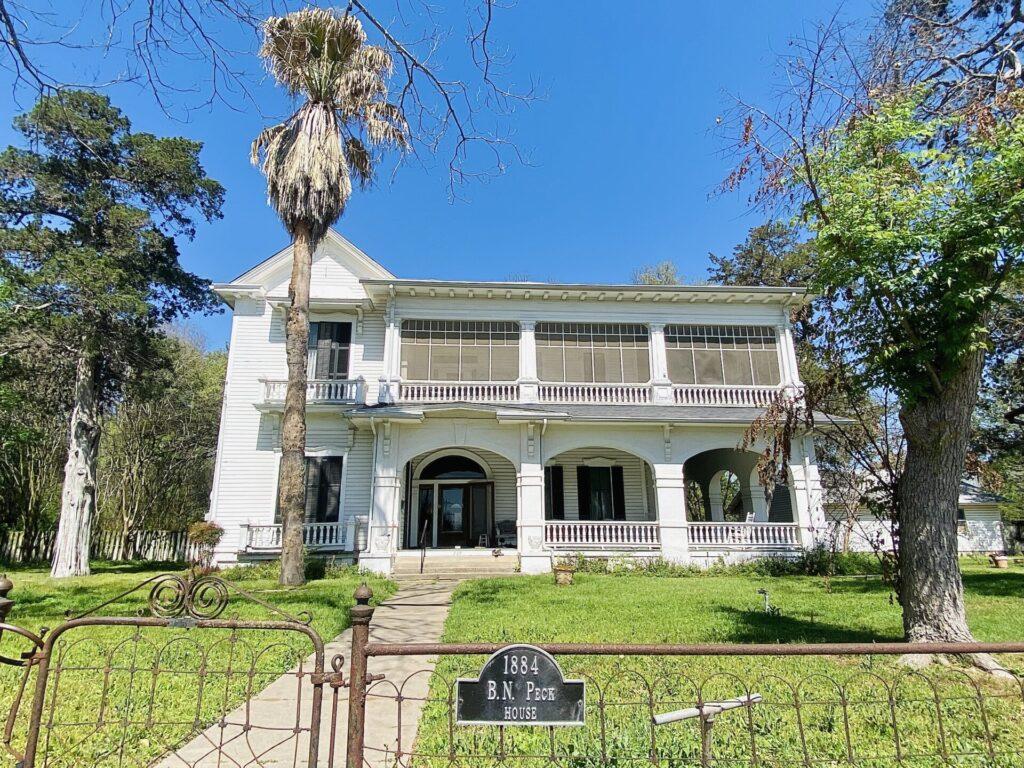
Built in 1884 for merchant Benjamin Nicholas “Ben” Peck, this Victorian residence is cited on Gonzales’s official tour as one of the city’s notable late nineteenth century homes. The listing places the house at 229 Saint Andrew Street and records a persistent local tradition that part of the dwelling was built around an earlier log cabin believed to have been erected by John and Nancy Cooksey in the 1850s.
People and context
Ben Peck was born July 25, 1856, son of B. B. Peck and Mary E. Peck. The Peck family is documented in Gonzales by 1850 and traces its local roots to the 1830s.
On December 19, 1882, Ben married Willie Monroe. She died May 3, 1887 during the birth of their only child, Willie Ben Peck. Nearly a decade later, on February 4, 1896, he married Josephine Kokernot (b. April 14, 1871), daughter of L. M. Kokernot and Sarah E. Littlefield Kokernot of the Big Hill ranching family. Handbook of Texas and regional cemetery records document the Kokernot family’s long presence east of Gonzales.
Peck’s business identity is linked to the three-story Peck and Fly Building on the west side of the courthouse square, where he partnered with W. M. Fly in a general store. The structure at 519 St. Joseph Street, with cast-iron detailed upper windows, is recorded by SAH Archipedia and by the Texas Historical Commission’s photo survey.
Ben operated the store until his death from appendicitis on January 7, 1913. Josephine died February 14, 1944. Family accounts and tour copy note continued Peck family ownership into the late twentieth century.
House history and features
City and tourism materials describe the dwelling as Victorian in style, completed in 1884, and possibly enveloping an older log cabin core from the Cooksey ownership period, 1854 to 1856. A 1970s Texas Historical Commission photograph further anchors the site in the state’s historic-resources inventory.
Interior finishes noted by local sources include original light fixtures, surviving wall coverings and draperies, and significant quantities of oak, walnut, and longleaf pine. A hand-carved walnut staircase rises to a large second-floor hall and to deep screened porches. Formal rooms are separated by substantial pillars at the entry and within the dining room. These details align with period craftsmanship documented in Gonzales homes of the 1880s.